Protecting Retirement Savings: The Role of Everyday Financial-Wellness Benefits

This National 401(k) Day, a Closer Look at What Can Help Keep Retirement Savings Intact
National 401(k) Day is an annual observance created to remind employers and employees alike just how important workplace retirement savings are to long-term financial security. For HR and benefits leaders, it is also an opportunity to check-in with their team about not only plan participation, but the financial pressures that can prevent employees from preserving those savings.
That check-in matters more than ever. New industry data shows retirement account balances are growing, but so is the number of employees who are dipping into those accounts before retirement to cover today's bills. That's where a voluntary benefit like Purchasing Power comes in, not as a replacement for a 401(k), but as a critical piece of the retirement readiness puzzle that helps employees avoid risking their future to pay for the present.
But 401(k) Day isn't just about encouraging people to save, it's also a moment to confront an uncomfortable trend: even as balances climb, more employees are being forced to tap those very accounts to survive financial emergencies and rising everyday costs.
The Retirement Paradox
Recent data paints a complicated picture of the American retirement landscape. On one hand, account balances are growing. According to Fidelity Investments, 401(k) balances climbed 11% and 403(b) balances rose 13% year-over-year from Q4 2024 to Q4 2025, helped along by market performance and rising use of automatic enrollment.1
On the other hand, growth is masking a troubling rise in early withdrawals. Vanguard's “How America Saves 2026” preview found that hardship withdrawal activity increased for the sixth straight year, with 6% of participants initiating a hardship withdrawal in 2025, up from just under 5% the year before and roughly triple the rate seen before the pandemic.1,2 Fidelity's data tells a similar story on the loan side: 19.4% of participants had an outstanding 401(k) loan in 2025, up from 18.9% in 2024 1.

The most common triggers for these withdrawals aren't discretionary purchases. They're foreclosure or eviction prevention and medical expenses.2 Vangaurd reports a median hardship withdrawal of around $1,900. And while the average withdrawal amount of approximately $1,900 may not sound dramatic, the long-term cost can be significant. At a hypothetical 8.5% annual return, that same $1,900 could grow to nearly $9,700 over 20 years if left untouched.2
[View our most recent webinar on demand: From Retirement to Real Life: Closing the Gap Between Long-Term Savings and Everyday Financial Needs]
As Vanguard's own researchers put it: easing rules around hardship withdrawals, combined with more workers being auto enrolled, means that for a subset of financially stressed employees, hardship withdrawals are increasingly serving as an unplanned safety net 2
Why Employees Access Retirement Savings
Fidelity's guidance on 401(k) loans and withdrawals is clear: retirement savings should be a last resort, not a first response to a cash need.1 Yet many employees may not be aware of other options in the moment. A 401(k) loan doesn't require a credit check and won't show up on a credit report, and unlike a hardship withdrawal, the money (plus interest) goes back into the employee's own account.3 That accessibility is exactly why it becomes so tempting and so risky for employees who lack other resources to cover an essential or unexpected expense.
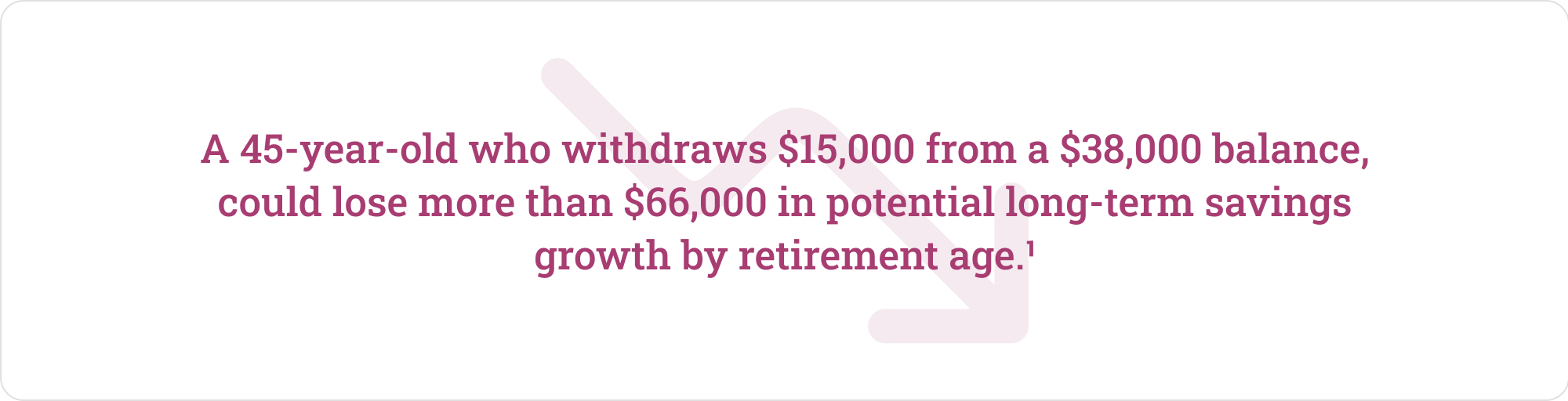
The problem is what borrowing from tomorrow costs today's growth. Fidelity’s modeling shows that a hypothetical 45-year-old who withdraws $15,000 from a $38,000 balance, rather than taking a loan, could lose more than $66,000 in potential long-term savings growth by retirement age1. Across a workforce, decisions like these may have broader implications for retirement readiness and financial well-being.
[Learn more about the financial wellness solutions Purchasing Power provides its users].
How Purchasing Power can complement a retirement strategy
This is precisely the gap Purchasing Power's employee purchase program was built to close. Instead of choosing between an unexpected expense, a retirement-account withdrawal, or high-cost borrowing, eligible employees can use Purchasing Power as another way to manage certain purchases over time.
Here's how the benefit fits into the broader retirement readiness picture:
- It can help employees avoid using retirement savings for eligible purchases. Purchasing Power gives eligible employees another option: a transparent way to purchase available products and services and pay over time through fixed payroll deductions, with no credit check, no interest, and no hidden fees. Whether it's new tires for your car, a new appliance, technology for a child starting school, employees can make the purchase through Purchasing Power secure platform.
- It can help employees avoid using retirement savings for eligible purchases. Purchasing Power gives eligible employees another option: a transparent way to purchase available products and services and pay over time through fixed payroll deductions, with no credit check, no interest, and no hidden fees. Whether it's new tires for your car, a new appliance, technology for a child starting school, employees can make the purchase through Purchasing Power secure platform.
- Offers an alternative to certain higher-cost borrowing options. Rather than reaching for a credit card at double-digit (or higher) revolving interest rates — a pressure point Vanguard's own research team has flagged as a driver of financial stress2, employees get transparent, fixed payments.
- It's simple, predictable, and built for real budgets. Payments are deducted directly from payroll in manageable installments, and eligible employees receive a preset spending limit, so the benefit supports better spending habits rather than open-ended debt.
Employee-reported and partner results
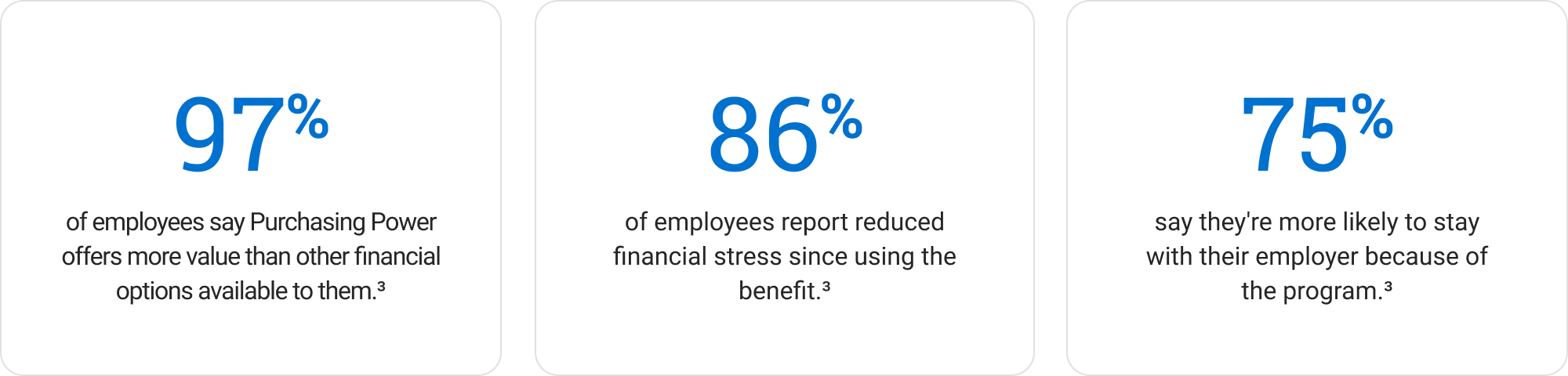
Purchasing Power's most recent Value as a Benefit survey found that 81% of employees say they are less likely to borrow from their retirement savings as a result of having access to the program.3 This employee-reported result demonstrates how voluntary benefits can complement a 401(k) strategy by giving employees another option when financial pressure arises.
That same research found additional signs of the program's impact on financial wellness and employee sentiment:
Real Results: HII's 44,000-Employee Workforce
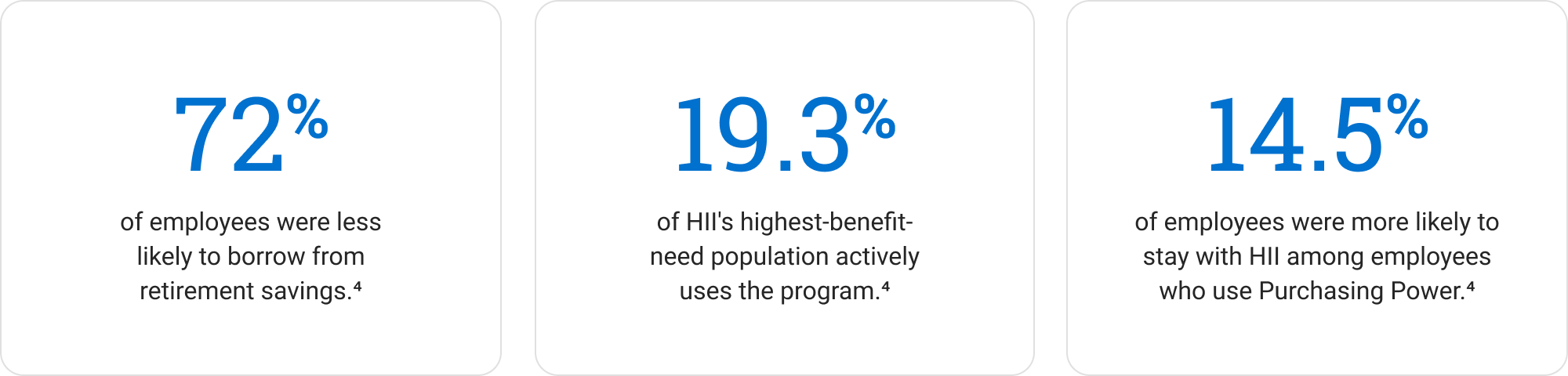
The impact shows up at the enterprise level, too. HII, America's largest shipbuilder and a global defense provider, had offered two 401(k) loan options before leadership recognized the approach was unintentionally delaying employees' ability to retire on time. After reducing its loan offerings to support long-term retirement readiness, HII partnered with Purchasing Power to fill the resulting gap for employees who still needed a way to cover essential and unexpected expenses.4
Data from Purchasing Power partner HII illustrate the benefit’s potential role in supporting retirement readiness:
As Kimberly Csan, HII's Corporate Director of Benefits, put it: the company isn't just there to provide a paycheck — it wants to make a genuine difference in employees' lives, on and off the job site.4
[See how HII partnered with Purchasing Power to help reduce reliance on 401(k) loans, fill a critical financial wellness gap and support employees’ long-term retirement readiness.]
A Complement to Your Retirement Strategy — Not a Competitor
It's worth being clear about what Purchasing Power is not: it's not a replacement for smart retirement planning, employer matching, or the guidance employees need to hit long-term savings benchmarks (whether that's saving roughly 15% of pre-tax income annually, as Fidelity recommends, or working toward multiples of salary at each age milestone).1 Retirement education, automatic enrollment, and strong plan design remain the foundation.
Purchasing Power can help employees protect that foundation by providing another way to manage eligible essential and unexpected purchases. It can provide another path for managing an eligible major purchase, such as replacing a refrigerator, without immediately turning to a hardship withdrawal, 401(k) loan, or high-interest credit card.
Want to see what this could look like for your workforce? Let's talk about how Purchasing Power can complement your benefits strategy and may help employees avoid or reduce reliance on retirement savings and hardship withdrawals across your organization.
Sources
1. Fidelity, “Thinking of taking money out of a 401(k)?” — https://www.fidelity.com/viewpoints/financial-basics/taking-money-from-401k
2. Vanguard, "Previewing How America Saves 2026" (2026), early preview of Vanguard's annual defined contribution plan research, cited for hardship withdrawal and loan trend data — https://workplace.vanguard.com/content/iig-transformation/pdf/previewing-how-america-saves-2026.html
3. Purchasing Power, Value as a Benefit Survey, featured on the Purchasing Power webinar landing page “From Retirement to Real Life” — https://info.purchasingpower.com/June2026-MarcusEvans.html
4. Purchasing Power Case Study, “Improving Financial Wellness and Retention Across HII's 44,000-Employee Workforce” (November 2025), citing HII's 2024 Transportation & Warehousing Value as a Benefit Survey — https://corp.purchasingpower.com/featured-case-studies/improving-financial-wellness-and-retention-across-hiis-44-000-employee-workforce